Animal-Origin Antibody Mapping
Exploring Animal-Derived Antibodies, Species Diversity, and Immunological Detection
Animal-origin antibody mapping explores the relationship between animal species, antibody characteristics, antigen recognition, and laboratory detection methods. In immunology and biomedical research, understanding the origin of an antibody is essential for selecting suitable reagents, designing reliable experiments, and improving the interpretation of protein detection results.
Antibodies are specialized proteins that recognize specific molecular structures known as epitopes. Researchers use these molecules to investigate protein expression, identify cellular markers, characterize biological pathways, and detect biomarkers associated with physiological and pathological processes. The animal species used to generate an antibody can influence its immunological properties, while the antibody format, target specificity, purification method, and detection system determine its suitability for a particular application.
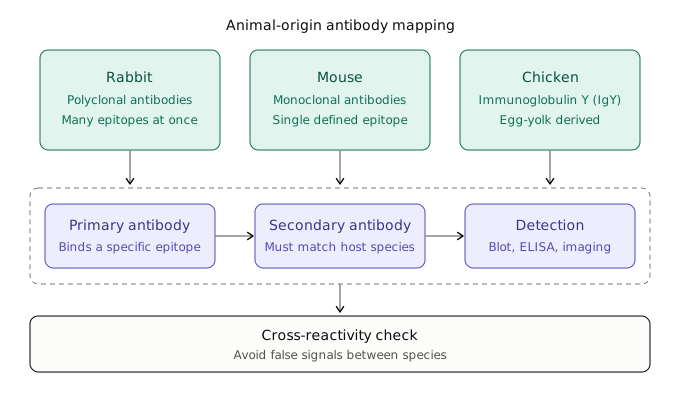
From rabbit polyclonal antibodies to mouse monoclonal antibodies and chicken-derived immunoglobulin Y (IgY), animal-derived antibodies provide diverse tools for studying biological systems. Exploring these differences helps researchers understand antibody selection, secondary antibody compatibility, cross-reactivity, and experimental reproducibility across a wide range of laboratory workflows.
Understanding the Relationship Between Animal Species and Antibody Recognition
Antibody production involves exposing an animal's immune system to an antigen or using established technologies to generate antibody-producing cell lines. The resulting antibodies recognize particular molecular features of the target. Depending on the production strategy, researchers may obtain monoclonal antibodies with a defined recognition profile or polyclonal preparations containing antibodies against multiple epitopes.
Different animal species offer distinct advantages for antibody generation. Rabbit antibodies are frequently selected for their strong immune responses to many antigens and their usefulness in protein detection. Mouse antibodies are widely associated with monoclonal antibody development and standardized clone-based applications. Goat and sheep antibodies are valuable in immunological reagent production, including secondary antibody systems. Rat monoclonal antibodies support cellular analysis and the investigation of specific biological markers, while chicken IgY provides an alternative to conventional mammalian immunoglobulins.
However, the species of origin alone does not establish antibody quality or experimental performance. Antigen specificity, affinity, validation data, sample composition, and compatibility with the selected detection method must also be considered.


Rabbit Antibodies: Broad Recognition for Protein Analysis
Rabbit-derived antibodies are widely used in molecular biology, immunology, and biomedical research. Their immune responses can produce antibodies recognizing multiple epitopes on a target antigen, making rabbit polyclonal antibodies useful in applications where signal sensitivity is important.
Rabbit antibodies are commonly investigated for Western blotting, immunohistochemistry, immunocytochemistry, immunofluorescence, and other protein detection workflows. Depending on the product, they may be available in purified or conjugated formats, including enzyme-linked and fluorescent detection reagents.
When selecting a rabbit antibody, researchers should evaluate the target protein, the biological species from which the sample originates, the validated application, and the availability of a compatible secondary antibody. These considerations help establish appropriate experimental conditions and reduce nonspecific signals. Learn more

Mouse Antibodies: Monoclonal Recognition and Experimental Consistency
Mouse-derived antibodies have an important role in antibody development, cellular analysis, and immunological research. Mouse monoclonal antibodies are generated from defined antibody-producing clones and are generally designed to recognize a particular epitope. This makes them useful for experiments requiring consistent target recognition across repeated analyses.
Mouse antibodies are frequently used in flow cytometry, Western blotting, immunohistochemistry, immunofluorescence, and antigen detection assays. Their performance depends on the antibody clone, target accessibility, sample preparation, and experimental protocol.
For multiplex experiments, researchers should pay particular attention to the host species of every primary antibody. If multiple primary antibodies originate from the same species, conventional secondary antibody detection may not distinguish them reliably. Direct conjugation or appropriately designed detection strategies may be required to separate the signals.

Goat and Sheep Antibodies: Supporting Specific Detection Systems
Goat-derived antibodies are widely used in laboratory reagent development, particularly as secondary antibodies that recognize immunoglobulins from other species. For example, an anti-rabbit secondary antibody produced in goat can bind to a rabbit primary antibody and facilitate its detection.
These secondary antibodies may carry horseradish peroxidase (HRP), fluorescent dyes, or other labels, depending on the intended application. Cross-adsorbed products can be especially useful when researchers need to reduce unwanted binding to immunoglobulins from other species.
Sheep-derived antibodies also contribute to immunological detection and reagent development. Their suitability depends on the antibody target, the intended role as a primary or secondary reagent, and the validation information provided for the specific product.
Understanding these distinctions is important because an antibody produced in an animal is not necessarily directed against proteins from that same animal. The production species and the target species are separate characteristics.

Rat Monoclonal Antibodies: Cellular Markers and Immunological Studies
Rat monoclonal antibodies are useful tools for identifying cellular proteins, investigating immune cell populations, and studying biological markers. Their applications include flow cytometry, immunohistochemistry, and other immunoassays in which selective antigen recognition is required.
The value of a rat monoclonal antibody depends on its specificity, clone characteristics, target accessibility, and compatibility with the intended sample. Researchers should also verify whether the selected secondary antibody recognizes rat immunoglobulins and whether additional cross-reactivity controls are necessary.
In experimental systems involving several antibody species, rat-derived reagents can provide another option for designing detection panels. Appropriate controls and validated secondary antibody combinations remain essential for interpreting the results accurately.

Chicken IgY: An Alternative Approach to Antibody Detection
Chickens produce immunoglobulin Y (IgY), an antibody class that differs structurally and functionally from mammalian immunoglobulin G (IgG). Chicken-derived antibodies are valuable in selected research applications because IgY can reduce certain interactions associated with mammalian IgG-based detection systems.
IgY antibodies may be used in ELISA, Western blotting, and other protein analysis methods when supported by product-specific validation. Their potential advantages depend on the target, sample type, and detection reagents.
Chicken antibodies can also be considered when researchers need to distinguish signals originating from different antibody species. As with other antibody formats, the suitability of IgY should be established through experimental validation rather than assumed from its animal origin alone.
Animal Antibodies and Recombinant Protein Production
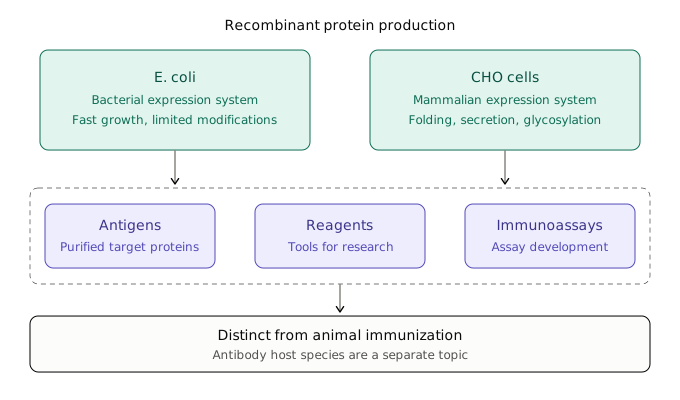
Animal-derived antibodies are part of a broader research environment that includes recombinant protein expression, antigen preparation, and immunoassay development. Systems such as Escherichia coli and Chinese hamster ovary (CHO) cells are particularly relevant to the production of proteins used in biological research.
E. coli is a bacterial expression system frequently employed to produce recombinant proteins because of its rapid growth and established laboratory methods. However, bacterial expression may not provide all the post-translational modifications required by certain complex proteins.
CHO cells are mammalian expression systems used to produce many recombinant proteins and therapeutic antibodies. They can support protein folding, secretion, and several mammalian post-translational modifications, including glycosylation. The suitability of either system depends on the target protein, required product characteristics, and downstream application.
These production platforms should be distinguished from animal species used to generate antibodies through immunization. They belong to the broader field of protein biotechnology and complement antibody research by supporting antigen production, reagent development, and experimental investigations.
Choosing Antibodies for Reliable Laboratory Workflows
Selecting an antibody requires more than identifying its animal species. A reliable selection process considers the biological question, the target antigen, the sample type, and the detection method.
Researchers should review the following characteristics before choosing a product:
Target specificity: Confirm that the antibody recognizes the intended protein, antigen, or cellular marker.
Antibody format: Determine whether a monoclonal or polyclonal antibody is appropriate for the experiment.
Production species: Identify the animal species used to generate the antibody.
Sample species: Check whether the antibody has been validated for the biological species represented in the sample.
Application validation: Review evidence supporting its use in ELISA, Western blotting, immunohistochemistry, immunofluorescence, or flow cytometry.
Secondary antibody compatibility: Ensure that the detection reagent recognizes the primary antibody without introducing unwanted cross-reactivity.
Applications of Animal-Origin Antibody Mapping
Animal-origin antibody selection supports numerous research areas, from fundamental molecular biology to translational biomedical investigations. Its practical relevance extends across several experimental techniques.
Protein expression analysis: Antibodies help detect specific proteins in biological samples and compare their relative abundance under different experimental conditions.
Cellular characterization: Antibody-based labeling allows researchers to identify cell populations, investigate cellular markers, and examine changes associated with biological processes.
Tissue investigation: Immunohistochemistry and immunofluorescence enable the localization of selected proteins within tissues and cells.
Biomarker detection: Immunoassays can measure target molecules associated with biological responses, disease mechanisms, and experimental models.
Multiplex detection: Carefully selected antibodies from compatible species can help distinguish multiple targets within the same sample.
Recombinant protein research: Antibodies support the characterization and detection of proteins produced through bacterial or mammalian expression systems.
Frequently Asked Questions About Animal-Origin Antibody Mapping
What does animal-origin antibody mapping mean?
Animal-origin antibody mapping refers to understanding and comparing antibodies according to their production species, recognition properties, and suitability for laboratory detection methods. It helps researchers evaluate antibody options for specific experimental objectives.
Why does the animal species matter when selecting an antibody?
The production species influences which secondary antibodies can be used for detection and how different primary antibodies can be combined in multiplex experiments. It may also affect antibody characteristics, but it does not independently determine specificity, sensitivity, or overall quality.
What is the difference between monoclonal and polyclonal antibodies?
Monoclonal antibodies originate from a defined antibody-producing clone and generally recognize one epitope. Polyclonal preparations contain multiple antibody populations that can recognize different epitopes on the same antigen.
Are rabbit antibodies better than mouse antibodies?
Neither species is universally better. Rabbit and mouse antibodies can differ in recognition properties, available clones, and suitability for particular applications. The most appropriate choice depends on the target, validation data, sample type, and detection method.
What is the role of a secondary antibody?
A secondary antibody recognizes a primary antibody and enables its detection, often through an enzyme or fluorescent label. Its specificity should match the primary antibody's species and immunoglobulin characteristics.
How can researchers reduce antibody cross-reactivity?
Researchers can use validated secondary antibodies, cross-adsorbed reagents where appropriate, suitable blocking conditions, and controls that reveal nonspecific binding. Multiplex experiments also require careful planning of primary antibody species and detection channels.
What is the difference between an antibody production species and a sample species?
The antibody production species identifies the animal used to generate the antibody. The sample species identifies the organism from which the tested tissue, cells, or proteins originate. These characteristics are independent and must both be considered during product selection.
Are E. coli and CHO considered antibody host species?
E. coli and CHO cells are primarily protein expression systems. E. coli is a bacterial host, while CHO refers to Chinese hamster ovary cells. Both can be used to produce recombinant proteins, but they are conceptually different from animals immunized to generate conventional animal-derived antibodies.
Advancing Antibody Selection Through Species Awareness
Understanding animal-derived antibodies provides a practical foundation for selecting immunological reagents, planning detection strategies, and evaluating experimental compatibility. Rabbit, mouse, goat, sheep, rat, and chicken antibodies each offer distinct possibilities, while recombinant expression platforms such as E. coli and CHO cells support the production of proteins used in research and biotechnology.
By integrating species information with target specificity, application validation, detection chemistry, and experimental controls, researchers can make more informed choices for protein analysis, cellular characterization, and biomarker investigation. Animal-origin antibody mapping therefore provides a useful framework for understanding the relationship between antibody production, molecular recognition, and reliable laboratory research.